Our Technology

Growing more.
Using less.
Living better.

We develop and produce Trichoderma asperellum-based biofertilisers, biostimulants, and biocontrol products — combining soil science, fermentation technology, and precision agriculture to deliver measurable benefits for farmers and the environment alike: higher yields, reduced reliance on synthetic fertilisers and fungicides, and lower nutrient losses to water and air.

Supported Project
The development of our pilot plant and fermentation technology is supported by the Estonian Business and Innovation Agency through the project "Trichoderma Technology: Innovative Solutions in Agriculture".

Project objective
To develop and validate an industrial-scale production technology for Trichoderma asperellum CB-17 spores — from fermentation and spore concentration through to formulation of bio-based fertiliser and biostimulant products — reaching TRL 6 by project end.
Project outcome
A validated pilot plant design and process scheme for spore concentrate and powder production, enabling commercial-scale manufacturing of biofertilisers, biostimulants, and high-value spore powder for B2B customers from 2028 onwards.

Where science becomes soil-ready technology

Together with our partners, we have developed a production facility purpose‑built for submerged and solid‑state fermentation using our patented Trichoderma asperellum strain — capable of producing pilot batches of bio‑based fertiliser and biostimulant products.

Our interdisciplinary team combines scientific rigour with entrepreneurial pragmatism — working alongside research partners, technological experts, forward‑thinking farmers, and dedicated supporters to bring this technology to market.

VIEW PILOT STATION GALLERY →
TRL 5–6
Current technology readiness level — pilot batches in production, field validation ongoing
Submerged &
Solid-state
Two fermentation routes — closely mimicking natural soil conditions, ensuring high-viability spores at scale
Biostimulant &
Biofertilizer
Our production facility is equipped to deliver pilot‑scale batches of both product types
TRL 8
Advancing toward TRL 8 through validated automation and scale‑up

Stable Formulations

CFU/g counts measured across product formulations from initial production through 48 weeks of storage, tracked against the sales standard based on the plant‑beneficial dose benchmark.

Spore stability is a hallmark of their quality
Maintains viability throughout
Products are resilient in practice – short‑term storage at higher temperatures before use is acceptable
Maintains viability throughout
Spore stability is a hallmark of their quality
Biofertiliser at +4 °C and RT maintains viability throughout
Products are resilient in practice – short-term storage at higher temperatures before use is acceptable
Biostimulant RT maintains viability throughout
Start
1 week
2 weeks
1 month
2 months
3 months
6 months
9 months
1 year
Sales standard
1,E+051,E+061,E+071,E+081,E+091,E+101,E+11Spore concentrateBiofertilizer +4 °CBiofertilizer RTBiofertilizer +28 °CBiostimulant RTStart1 week2 weeks1 month2 months3 months6 months9 months1 yearSales standardSpores stability is a hallmark of their stabilityProducts are resilient in practice short terms storage at higher temperatuures before usse is acceptableMaintainsviability throughoutMaintainsviability throughout

Better yields.
Better soil.
Better future.

Our biostimulant and biocontrol products deliver measurable value at every level — for the farmer managing day-to-day crop performance, for the environment bearing the cost of intensive agriculture, and for the food system that depends on both.

Disease suppression & reduced fungicide use

Trichoderma asperellum colonises the root zone and actively suppresses soil-borne fungal pathogens including Fusarium, Rhizoctonia, and Pythium. The result is healthier crops — and fewer fungicide applications.

Biocontrol

Phosphorus mobilisation from soil reserves

A large fraction of soil phosphorus is bound in mineral forms unavailable to plants. Trichoderma secretes organic acids and phosphatases that unlock this legacy phosphorus — reducing the need for synthetic P fertiliser inputs.

Nutrient Efficiency

Plant growth stimulation

Trichoderma asperellum promotes root development and stimulates natural plant defence mechanisms, leading to stronger, more resilient crops with improved nutrient uptake throughout the growing season.

Biostimulation

Reduced nutrient emissions to water and air

Improved nutrient use efficiency means less excess fertiliser in the system — directly reducing nitrogen and phosphorus losses to waterways and lowering N₂O emissions from over-fertilised soils.

Environmental

Safer food and soil ecosystem

Reducing chemical inputs — fungicides and synthetic fertilisers — means fewer residues in the food chain and a healthier soil microbiome. Our product supports the transition to regenerative and sustainable agriculture.

Soil Health

Supporting the EU Farm to Fork agenda

Our product directly addresses two of the Farm to Fork Strategy's headline targets: a 50% reduction in chemical pesticide use and a 20% reduction in fertiliser use by 2030 — without compromising crop yield or farmer income.

Policy Alignment

Bio-based profit-driven field practice

Initial open-field and greenhouse trials have shown yield increases of up to 15% compared to untreated controls.

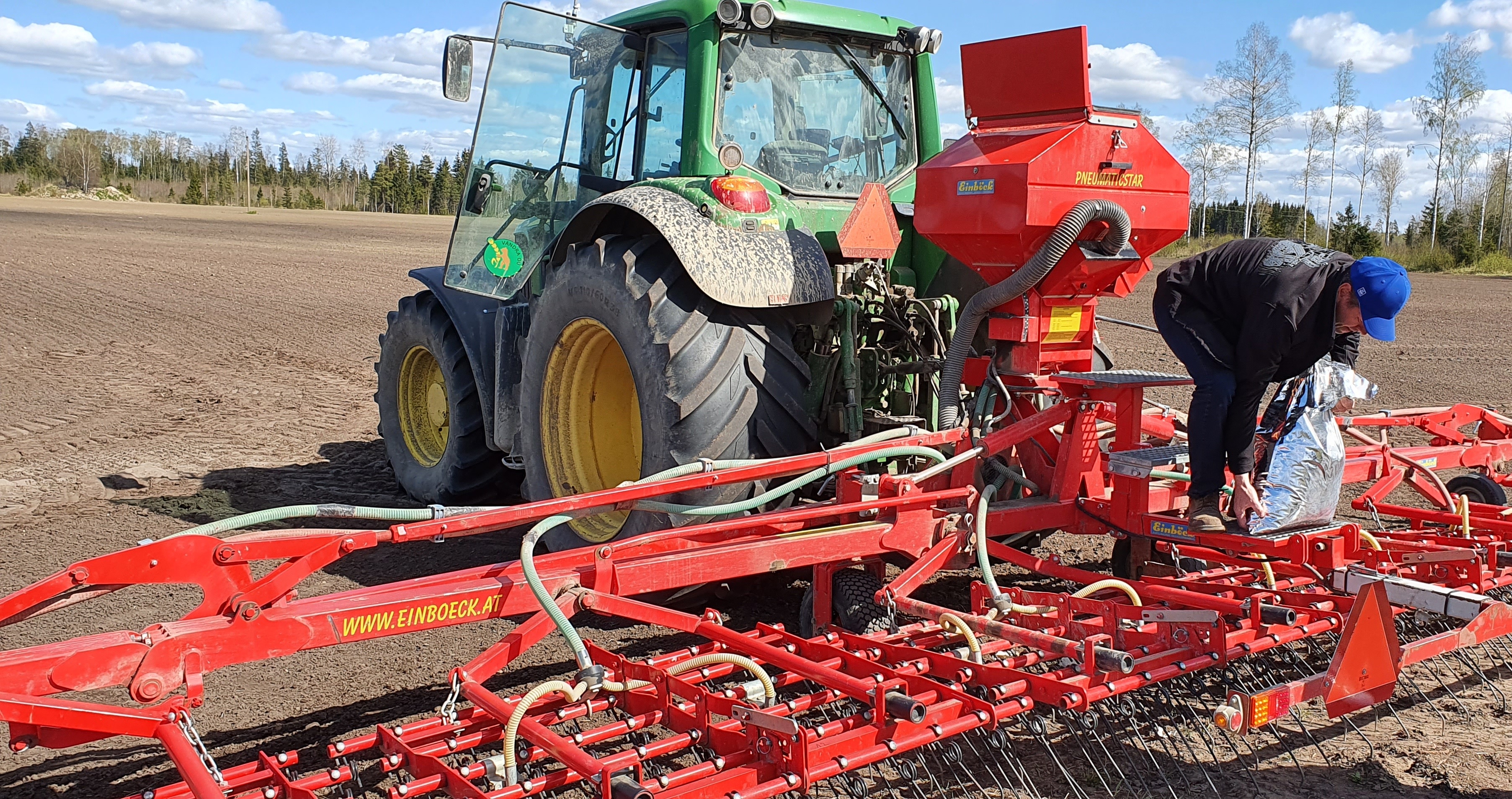
Field photo

Applying biofertilizer with a precision seeder during spring sowing.

VIEW FIELD TESTS GALLERY →
  • 📊 Measurable agronomic feasibility
  • 🌱 Environmental benefits
  • 🤝 Our plot and field trials are designed and executed with specialist agronomic partners
  • 🎯 Aligned with precision agriculture tools
  • 📡 Digital monitoring ensures data quality and reproducibility
+15%
Yield increase
Yield increase observed in initial plot and field trials compared to untreated control
Systemseparation OÜ · Tartu, Estonia
10–15 ha
Plot trials
We have carried out 10–15 ha plot trials on a variety of crops
Systemseparation OÜ · Tartu, Estonia
↓P
Phosphorus input
Positive impact on phosphorus use efficiency — reduced synthetic P fertiliser requirement with maintained yield
Systemseparation OÜ · Tartu, Estonia
GHG↓
Emissions footprint
Reduced nutrient emissions to water and lower greenhouse gas footprint through precision fertilization
Systemseparation OÜ · Tartu, Estonia
Our Team

The people behind the technology

Siiri Velling
Siiri Velling
PhD · Chief R&D Officer
Urmo Pakkas
Urmo Pakkas
Chief Technology Officer
Anna Murulauk
Anna Murulauk
Coordinator
Get in touch

Interested in our technology?

We are actively seeking multi‐actor partnerships for upcoming calls. Our proven Trichoderma asperellum technology provides a strong foundation for next‐generation sustainable agriculture projects. We welcome long‐term partnerships with manufacturing partners for production and scale‐up, as well as agricultural users and research partners.

Company
Systemseparation OÜ
Estonia, Tartu
Partnership
Open to collaboration
Manufacturing · Research · Agriculture